


Can I ask you a question?
If someone told you they made $100,000 a year, would you consider that a good salary?
Pat certainly did. Growing up in the Midwest, six figures meant you’d made it. You could afford a nice place, drive a decent car, take vacations, go out to dinner without studying the menu prices, and still save money.
At 32, Pat had reached that milestone. He managed a high-end restaurant in Miami, earned $100,000 a year, and spent his evenings surrounded by people who seemed to have considerably more money than he did.
He’d watched guests order $300 bottles of wine without asking the price. One regular had a favorite table, a favorite waiter, and apparently no interest in checking the bill. Pat liked his job, but working around Miami’s wealth every night had a funny way of changing what he considered normal.
He’d also assumed meeting women would be easy. He worked in one of the most social environments imaginable, knew half the hospitality crowd in the city, and could recommend a great restaurant for practically any occasion. Unfortunately, knowing where to take someone on a date and actually having someone to take were two different skills.
Still, life was good. He had friends, a career, and enough money to enjoy the city. Or at least he thought he did until he started looking at how much of that $100,000 he was actually keeping.
Across town, Darlene and James were having a different conversation about the same number.
Darlene was 34 and worked as a physical therapist. James, 35, was a financial analyst. Both earned approximately $100,000, giving them a combined household income of $200,000. They had a 10-month-old baby, established careers, and savings they’d built over several years.
They enjoyed their life in Miami. On Saturday mornings, they usually had breakfast somewhere with outdoor seating, a stroller that seemed unnecessarily complicated to fold, and a conversation about where they might eventually buy a home.
Darlene loved Coconut Grove. She liked the trees, the restaurants, and the idea of walking somewhere with the baby without making an entire production out of it. James liked Coconut Grove, too, although he had developed the unfortunate habit of checking home prices whenever she mentioned it.
They wanted to buy their first home, preferably somewhere they could stay for years. Neither wanted to give up everything they enjoyed about Miami just to make it happen.
James spent his days analyzing numbers, which made it particularly irritating that every time he revisited their household budget, something seemed to have gotten more expensive.
Darlene thought he was overthinking it. James thought the numbers deserved another look. Their baby, who had recently developed a preference for being carried around the house, had no opinion on the housing market.
The question for both households was essentially the same: How much life does $100,000 actually buy you in Miami?
Pat had been looking at apartments in Brickell. He liked the idea of walking to restaurants, meeting friends for drinks, and living somewhere that felt unmistakably Miami. But every apartment he liked came with another expense. There was the rent, the parking, the building fees, and the uncomfortable realization that a rooftop pool didn’t necessarily mean he’d ever have time to use it.
A one-bedroom apartment in a desirable Miami neighborhood could easily cost him around $2,700 a month. For Pat, that meant more than $32,000 a year in rent before utilities, parking, or anything else.
He could afford it. That wasn’t really the question. The question was what he would have left afterward.
On paper, his $100,000 salary worked out to $8,333 a month. After federal income taxes and payroll taxes, he might take home roughly $6,400 a month, before any voluntary retirement contributions or benefit deductions. A $2,700 apartment would take a substantial bite out of that.
Then came the car, insurance, groceries, phone, gym, entertainment, and the occasional weekend away. Pat wasn’t spending recklessly, but he was discovering that Miami could turn ordinary activities into expensive ones. A dinner with friends in Brickell, a couple of drinks, and valet parking could easily add up to $150. Pat had once spent twenty minutes looking for street parking in Wynwood, finally paid $30 to park, and then walked past three empty spaces on his way to the restaurant. Miami had a way of making even the parking feel personal.
He had money left over most months. He had savings from earlier in his career and wasn’t living paycheck to paycheck. But buying a condo someday was starting to feel more distant than he’d expected.
Darlene and James had a different advantage. Two incomes made it easier to absorb the cost of housing, and they had already spent several years saving and investing. Their combined $200,000 gave them more flexibility than Pat had, even after accounting for their baby.
But their priorities were different, too.
They needed a second bedroom, preferably a third if they could find one at the right price. They wanted a neighborhood where they could take the baby for walks, get to work without spending half their lives in traffic, and eventually buy a home. They also needed dependable childcare, which was an expense Pat had never had to consider.
The couple had looked at several apartments they liked, but Darlene kept returning to the same question: Why pay more for a rental when they were trying to save for a down payment?
James agreed, though he cared less about the down payment than what came afterward. Between the mortgage, property taxes, insurance, and potential HOA fees, owning a home was beginning to look considerably more expensive than simply saving for one.
The numbers weren’t terrible for either household. In fact, MIT’s Living Wage Calculator estimates that a single adult in Miami-Dade needs roughly $54,000 before taxes to cover basic necessities, while two working adults with one child need approximately $99,000 combined. Both households earned considerably more than those amounts.
But necessities weren’t the whole story. Pat wanted to enjoy the city he’d moved to. Darlene and James wanted to buy a home without spending the next several years declining every invitation that involved leaving the house.
What Their Money Actually Looks Like
Here’s what a typical month might look like for both households.
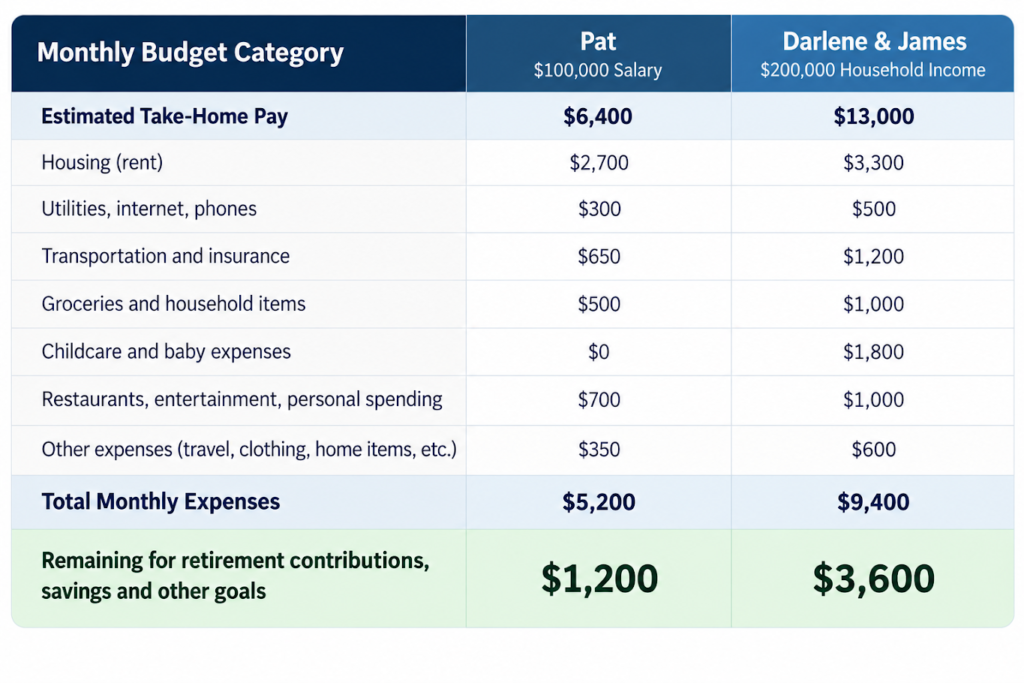
Illustrative monthly estimates. Actual taxes, benefits, housing costs, and household expenses will vary.
But when Pat thought about buying a condo, the math changed. A down payment was one thing. A mortgage, property taxes, insurance, and HOA fees were another.
He liked Brickell, but he was beginning to wonder whether he liked it enough to spend that much of his income living there.
Darlene and James were having a similar debate about Coconut Grove. They could afford a comfortable rental and continue saving toward a home, but buying in the neighborhood they loved was another conversation entirely.
James had suggested looking farther west. Darlene wasn’t opposed, but she wasn’t particularly excited about trading their weekend walks for more time in the car. They’d both worked hard to reach this point in their careers, and neither wanted homeownership to mean giving up what made living in Miami enjoyable.
So Where Should They Live?
Pat had initially focused on Brickell, and it was easy to see why. The restaurants, nightlife, waterfront, and concentration of young professionals were exactly what he’d imagined when he moved to Miami.
But he also worked long evenings, so he wasn’t always taking advantage of everything he was paying to live near.
Dadeland started looking more interesting. Around Downtown Dadeland and Dadeland Mall, he could find apartment buildings, restaurants, shopping, and Metrorail access without giving up the convenience of having things nearby. Downtown Miami was another possibility, particularly if he wanted to stay closer to the nightlife and restaurant scene. Neither guaranteed a cheaper apartment, but both offered alternatives to paying a premium for the Brickell lifestyle he’d imagined. Of course, where he worked and how late he finished his shifts would ultimately matter more than the rooftop pool.
The decision wasn’t really about whether Pat could afford Brickell. He could. It was about whether living there was worth the trade-off in savings.
For Darlene and James, the conversation was more complicated. Coconut Grove remained Darlene’s favorite, but they also started looking at Kendall and Doral. Kendall appealed to them with its established residential neighborhoods, parks, and the chance to get more space for their money. Doral offered newer communities, restaurants, and places where they could spend an afternoon with the baby without driving across Miami. Neither had quite the same atmosphere as Coconut Grove, but both deserved a closer look, especially if they could find a rental that shortened their commutes and helped them save for a home.
They weren’t in a rush to buy, so they had time to find a rental that worked for their family while they kept saving for the right home.
And that brings us back to the original question. Is $100,000 a good salary in Miami?
For Pat, the answer was yes. His $100,000 salary let him enjoy Miami, maintain a comfortable lifestyle, and keep saving. He just had to decide whether paying a premium to live in Brickell was worth what he might be giving up elsewhere.
Darlene and James had more financial flexibility with their combined $200,000, but their goals were different. They weren’t simply looking for a place to live. They wanted a home where they could raise their child, build memories, and hopefully stay for years.
Pat expanded his apartment search beyond Brickell. Darlene and James explored other neighborhoods but kept Coconut Grove on their list. They still wanted the same things they did when they started looking, but now they understood what those things would cost. And in a city like Miami, that might be worth knowing before you fall in love with the apartment, the neighborhood, or the view.
Finding Your Place in Miami
Whether you’re renting, buying your first home, or exploring a new neighborhood, Miami Deal Flow can help you understand your options and find the right fit. Call Brian at 786-330-8948 or start here.