Can I ask you a question?
What happened to Wynwood?
There was a time when Wynwood felt like Miami had accidentally left a few blocks alone. The neighborhood was warehouses, galleries, graffiti, artists, bars, and people who didn’t particularly look like they had checked the dress code before leaving the house. On a busy night outside Wood Tavern, you could see somebody smoking weed a few feet away from a cop, and somehow neither one seemed especially interested in what the other was doing.
It was weird, but in the best possible way.
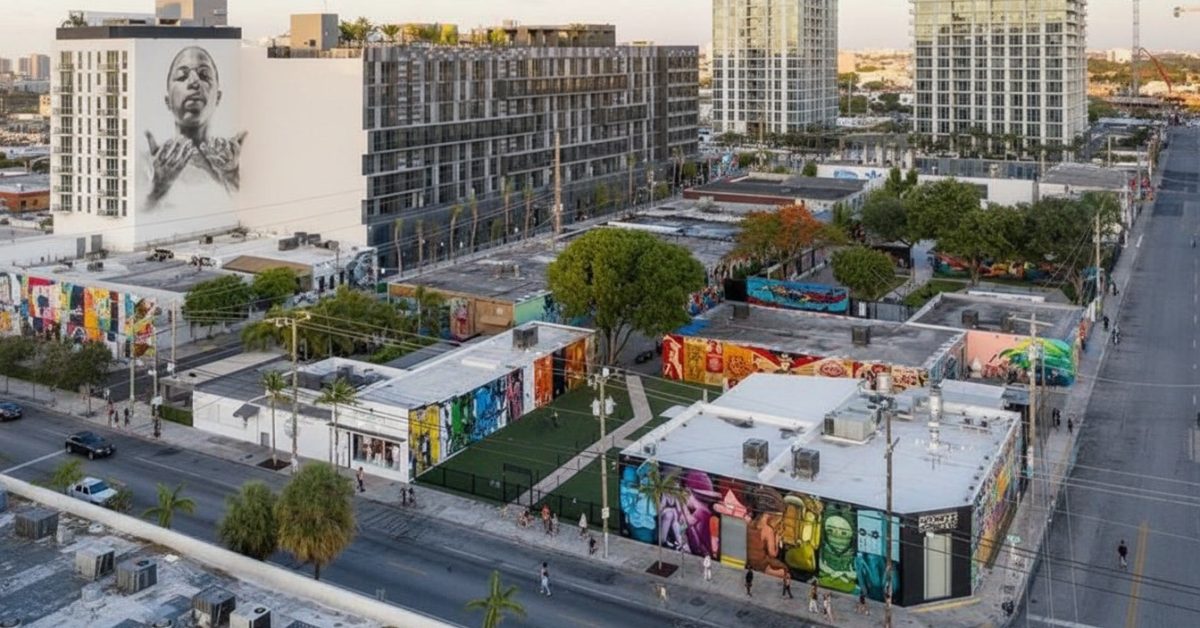
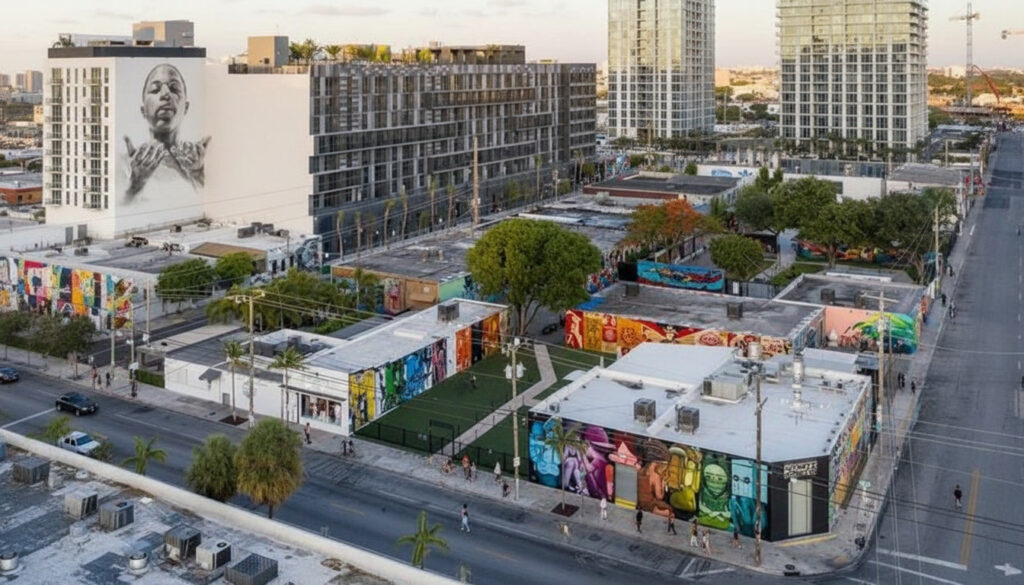
On Art Walk nights, people just walked. You didn’t necessarily need reservations or even much of a plan. You wandered through galleries, stopped to look at whatever somebody had painted on a wall, grabbed a drink and kept moving. Artists and entrepreneurs shaped the neighborhood by moving into old warehouses and factories after much of the area had been left behind by its previous industries. By the early 2000s, galleries, studios and street art were turning those buildings into something completely different.
Let’s call that Wynwood 1.0.
Nobody sat in a conference room and invented it, which is probably why it worked.
Wynwood 2.0
Eventually, everybody figured out Wynwood was cool.
It didn’t happen all at once. The murals were still there. Art Walk was still packed. Wood Tavern, Gramps, Panther Coffee, Coyo Taco and plenty of other places gave people even more reasons to hang around. You could spend an entire afternoon or night in Wynwood without stepping inside a gallery, and increasingly, that’s exactly what people did.
Wynwood wasn’t just an arts district anymore. It had become a destination.
Tourists came. More businesses followed. And once enough people wanted to be there, the land underneath all that graffiti started becoming really valuable.
By 2015, Miami had approved a new zoning plan to shift Wynwood from its industrial roots into a denser mixed-use neighborhood, allowing more residential and office development while trying to preserve the art and industrial character that made the place interesting in the first place. Even then, the people behind the plan were talking about the challenge of adding development without losing Wynwood’s funky identity.
Ten years later, you can walk around and see how that experiment turned out.
There are still murals and plenty of art, and nobody will confuse Wynwood with Brickell. But now you can walk past an old warehouse, a luxury apartment building, an office, and a hotel without leaving the neighborhood. Amazon and Spotify have moved in. People actually live here now, thousands more than when the rezoning happened, and new projects keep coming.
You can also buy a furnished residence at NoMad Residences Wynwood, go downstairs to Casa Tua, work from the building, spend the afternoon at the rooftop pool, and rent your place when you’re not in Miami. There is nothing wrong with that version of Wynwood. In fact, it’s pretty damn nice.
It’s just not Wynwood 1.0.
Somewhere during all that progress, the places that helped make Wynwood cool started disappearing. Galleries moved. Electric Pickle closed. Wood Tavern closed. Gramps closed. The neighborhood that became valuable because people wanted to be there eventually became expensive enough that some of the people and businesses that helped create it couldn’t stay.
That’s usually where the conversation turns to gentrification, but lately something else has been happening that makes Wynwood more interesting. For all the beautiful buildings and expensive restaurants, some of those restaurants aren’t particularly full.
This summer, Shiso Asian Smokehouse stopped regular dinner service just 16 months after opening, converting the space into an event center while keeping Shiso as its catering operation. Days later, Niño Gordo closed its first U.S. location in Wynwood after a little more than a year, despite the original Buenos Aires restaurant having earned international recognition.
Walk around at the wrong time, and you can start wondering whether Wynwood became too expensive for its own good. Beautiful buildings. Expensive restaurants. Plenty of investment. And somehow, a few too many empty tables.
Maybe the cool neighborhood became so successful at being cool that it changed the math.
And that’s where the story starts feeling familiar. At some point, everybody begins looking for the next neighborhood that feels like this one used to feel.
You could make a pretty convincing argument that Wynwood is somewhere near the end of that cycle. You could make almost the exact same argument about Miami.
Drive around the city right now, and it’s hard not to wonder how the math works. There are cranes everywhere. New condo towers keep getting announced. Houses that didn’t seem particularly extraordinary a few years ago now have extraordinary prices. Restaurants are expensive. Insurance is expensive. Living here is expensive. Meanwhile, another developer announces another building with another eight-figure penthouse, and apparently somebody is buying it.
From outside Miami, that story has an obvious ending. At some point, this thing has to bust.
Except the money keeps showing up.
Miami has become extraordinarily difficult to afford on a normal local income, while the upper end of the market increasingly seems to operate in a different universe. You can look at the price of a house, a condo or even dinner and wonder who keeps paying these prices.
Then somebody does.
That’s the strange part. Prices can stop making sense to people who remember what something used to cost without stopping the next person from deciding it’s worth even more.
Which brings us to Ken Griffin.
Wynwood 3.0?
At the end of September, Griffin bought roughly 30 acres of the Mana Wynwood complex for about $1.1 billion. Earlier this year, Griffin and Goldman Properties had already acquired 545 Wynwood, the large office building in the neighborhood, for about $180 million.
So while restaurants were closing and people were debating what happened to Wynwood, a guy with a lot of money was quietly putting an extraordinary amount of it into the neighborhood. And then came Carnegie Mellon.
Griffin gave Carnegie Mellon University $3 billion, the largest individual gift in the history of American higher education, with $2 billion going toward launching a new Carnegie Mellon campus in Wynwood. Construction is expected to begin in 2027, with the first students arriving as early as 2028. The university ultimately expects more than 3,500 students along with hundreds of faculty and staff.
Now go back and walk past that empty restaurant again. It looks a little different. Not necessarily better, just different, because Griffin isn’t spending all that money to bring back the old Wynwood. Wood Tavern isn’t reopening. The warehouses aren’t suddenly getting cheaper, and nobody is turning the clock back to Art Walk in 2011. Whatever he’s betting on doesn’t completely exist yet.
Wynwood 1.0 gave people a reason to discover the neighborhood. Wynwood 2.0 gave everyone else a reason to visit. Wynwood 3.0 may be trying to give thousands of people a reason to wake up there on a Tuesday morning.
And Tuesday morning might matter more than it sounds.
Someone needs coffee at 8:15. Somebody else needs lunch between classes. Someone lives upstairs and realizes there’s nothing in the refrigerator. A professor moves to Miami and needs somewhere to live. A company wants to be near the university. A graduate decides to stay and start something. By dinner, some of them are still there.
That doesn’t mean every new development works or every restaurant survives, and it definitely doesn’t mean someone should buy a condo in Wynwood because Ken Griffin bought 30 acres nearby. Carnegie Mellon hasn’t opened yet, buildings can be overbuilt and buyers can absolutely pay too much for the promise of what a neighborhood might eventually become.
But that empty restaurant and the $1.1 billion land purchase can exist on the same street without either one being wrong.
Maybe what’s struggling is the version of Wynwood we got used to.
That possibility gets even more interesting when you pull back from Wynwood and look at Miami. The city has become extraordinarily expensive, with very real consequences for the people and businesses that can no longer afford to be here. But expensive isn’t the same thing as collapsing.
Maybe Miami isn’t approaching an end. Maybe, like Wynwood, it’s becoming something different.
The old Wynwood had something money couldn’t manufacture. Then the money arrived and changed it. Now even more money is arriving, except this time it isn’t just opening another restaurant or putting another logo on a storefront. It’s building homes, offices and, potentially, an entire university ecosystem.
Somewhere between somebody smoking weed next to a cop outside Wood Tavern and a billionaire spending more than $1 billion on 30 acres, Wynwood became something nobody standing on those streets years ago could have predicted.
The next version may be even harder to recognize.
The question isn’t whether Wynwood can get bigger anymore. It already has. The more interesting question is whether a neighborhood can become this valuable, this developed, and this important without eventually sanding away every weird little thing that made people care about it in the first place.
Can you go big and still maintain your integrity?
Wynwood 3.0 might be about to give us the answer.